One of the reasons physical color draping can be so revealing is that the fabric doesn’t simply sit next to your face.
It changes the light on your face.
A warm coral reflects a different color back onto your skin than a cool berry. Soft sage creates a different reflected cast than deep teal. Each drape has its own effect - and that reflected light is part of what can make the face look brighter, clearer, softer, more defined, or sometimes a little duller.
Until now, most virtual draping could show you how a color looks beside your face. But it couldn’t really show you what that color might do to your face.
That’s the part we wanted to change.
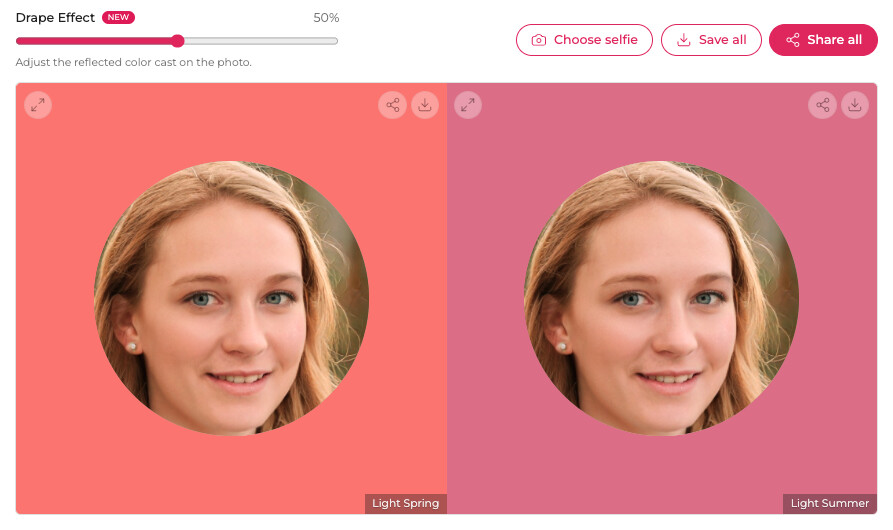
Colorwise virtual draping now calculates a different reflected-color effect for every individual drape and simulates that effect on your photo.
Not a generic warm filter for warm colors. Not a cool filter for cool colors. Every drape produces its own carefully calculated color shift, just as every physical fabric reflects its own color of light.
Every drape really does something different
Think about what happens in a real draping session.
Put a coral fabric beneath your face and some of that coral-colored light bounces upward. Replace it with raspberry and the reflected light changes. Switch to sage, cobalt or cream, and it changes again.
The fabric color, the light and your skin all interact.
That is why simply pasting a colored rectangle underneath a selfie can never fully reproduce physical draping.
Our new model goes a step further.
For every draping color, Colorwise calculates the color of the reflected-light effect and applies that shift to the image. So when you switch drapes, you are not only changing the fabric on screen - you are changing the simulated light reaching your face as well.
That brings us much closer to the experience we actually care about:
Not just “How does this color look next to me?” but “What does this color do to me?”
There was, however, one big scientific question we needed to answer first.
Can skin really be simulated this way?
Human skin is more complicated than a color swatch.
Two skin samples can look like exactly the same color under one light while being made up of slightly different spectral reflections. Under another light, those seemingly identical samples can separate a little.
There is a wonderfully nerdy word for this: metamerism.
In plain English:
Two colors that match in one light can look slightly different in another.
If this effect were large and unpredictable in human skin, virtual draping would have a serious problem. A photograph could tell us the starting skin color, but not exactly how that skin would react when the reflected light changed.
So we tested it.
And this is where things got interesting.
We’ve been trying to bring real draping home for years
There’s a funny bit of Colorwise history behind this update.
Back in March 2024, when we introduced the Color Analysis Camera in our My Best Colors app. We wrote that physical draping creates a unique glow on the skin that “just can’t be replicated digitally.”
At the time, we meant it.
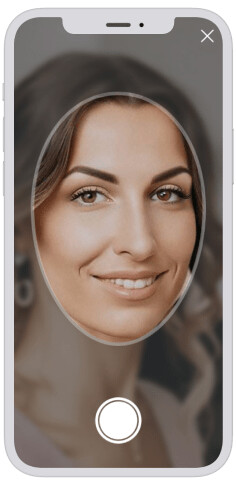
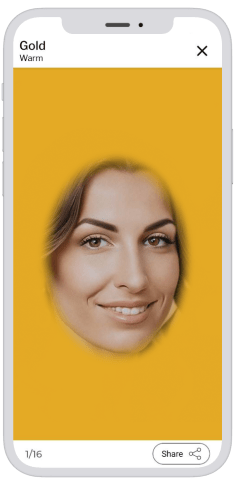
So instead of trying to fake that interaction with image editing, we took another route: create the reflected light for real. The Color Analysis Camera uses the phone itself to expose your face to different colors while taking the photos. It gives you a way to observe that changing-color effect at home, without needing a professional draping set.
And the Color Analysis Camera is still a great way to do exactly that.
But science moved on.
Almost unbelievably, exactly one year after that original post, on March 23, 2025, researchers published the International Skin Spectra Archive (ISSA) - 15,256 detailed spectral measurements of real human skin from 2,113 people.
That dataset gave us something we simply didn’t have when we made the Color Analysis Camera: enough real spectral skin data to ask whether the reflected-light effect could actually be calculated reliably from a measured skin color.
So we went back to the question we had essentially declared impossible a year earlier:
Can we reproduce the effect digitally after all?
The answer surprised us.
Much more closely than we thought.
That doesn’t make the Color Analysis Camera obsolete. In fact, the two approaches now complement each other beautifully.
The Color Analysis Camera creates the changing light physically, using your phone, and records how your own face responds.
The new Virtual Draping model calculates and simulates that reflected-light effect directly on a photo.
Two different ways of getting closer to traditional draping - and neither requires leaving home.
Metamerism is real. Fortunately, it is usually tiny.
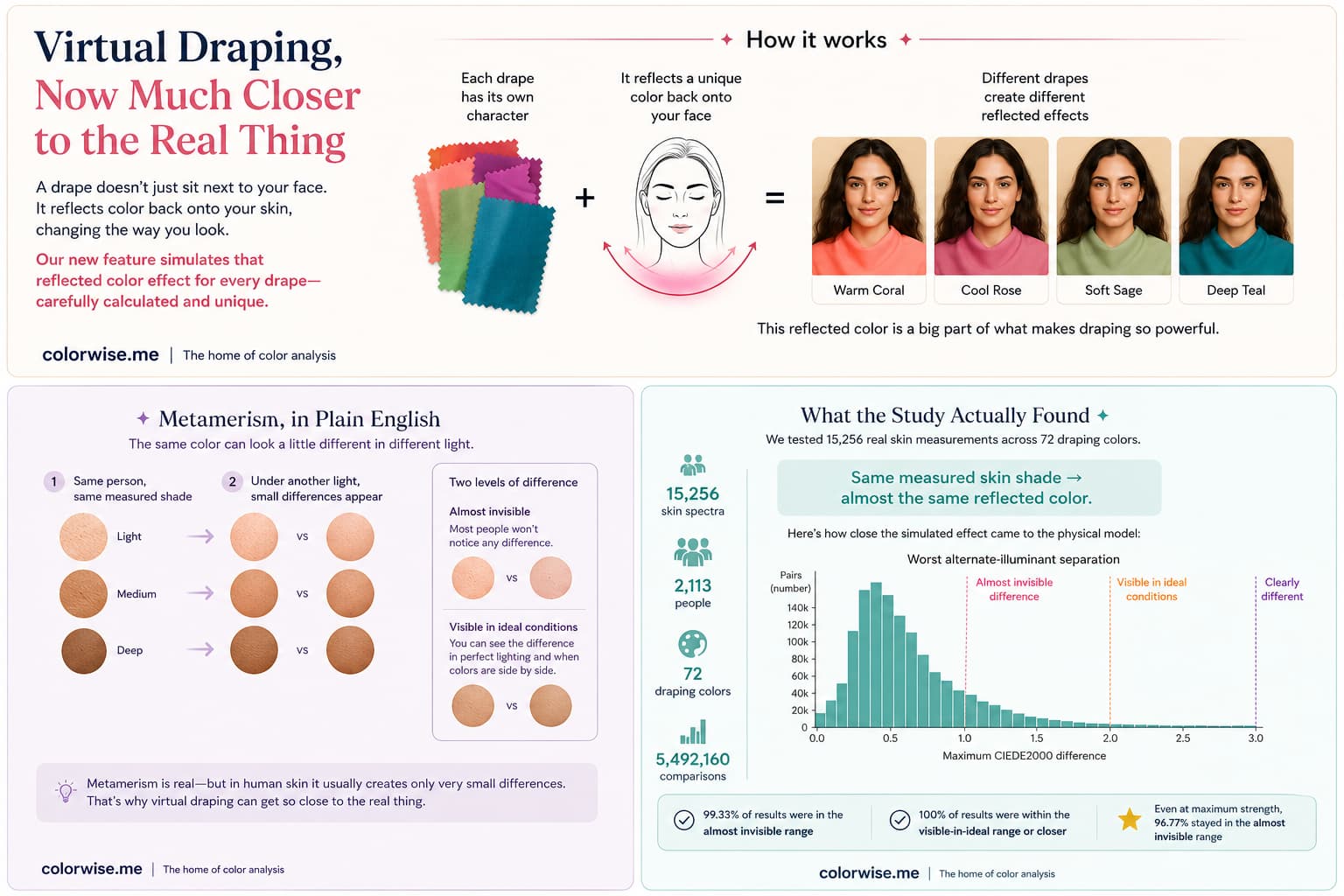
We used the ISSA / Leeds Skin Database, a large scientific dataset containing 15,256 measured skin spectra from 2,113 people.
Instead of treating skin as a simple RGB color, these measurements tell us how real human skin reflects light across the visible spectrum.
That allowed us to ask a very specific question:
If two skin samples begin at the same measured color, can their response to a new reflected color become meaningfully different?
We tested the skin data against all 72 draping colors used in our system.
Altogether, the validation produced more than 5.4 million comparisons.
And the result was remarkably consistent.
In the vast majority of cases:
Same measured skin color → almost the same reflected-color shift.
That is the important part.
Different people obviously have different skin colors, and the same drape will produce different final colors on different starting skin tones.
But once we know the starting skin color, the way that color shifts under the simulated reflected light is highly predictable.
The hidden spectral differences between two apparently matching skin colors usually make almost no visible difference.
In 99.33% of our comparisons, the difference was in a range that would be almost invisible.
And every single comparison stayed within a very small difference - something you would generally need ideal viewing conditions and a direct side-by-side comparison to notice.
Even when we deliberately tested the strongest reflected-color effect in the model, 96.77% of the results were still in the almost-invisible range.
That was the result we were hoping for.
Why this matters for virtual draping
It means we don’t have to pretend every face behaves like the same generic surface.
We can start from your actual color and calculate what each individual drape does to it.
A coral drape creates its coral-derived reflected effect. A raspberry drape creates a different one. Teal creates another. Yellow another.
And because real human skin behaves very consistently in our validation, those calculated shifts remain extremely close to what the physical model predicts across a huge range of skin colors.
This is the difference between simply putting colors around a photograph and trying to simulate the thing that makes physical draping interesting in the first place:
reflected light.
Does this replace physical draping?
Physical draping is still physical draping.
Real fabric has texture. Real rooms have complex lighting. The angle of the fabric matters. So does distance from the face. And two textiles that appear to have the same digital color can have different spectral properties.
We are not claiming that a screen has suddenly become a piece of fabric.
What the science tells us is something more useful:
A carefully calculated digital model can reproduce the reflected-color effect surprisingly closely.
That means you can now explore an important part of real draping at home, instantly switching between colors and seeing not only the drape change, but the simulated reflected light change with it.
For something that happens inside a browser, that is pretty exciting.
A small word about lighting
Good input still matters.
If a photograph was taken under strongly colored or uneven lighting, the camera may already have changed the apparent skin color before virtual draping even begins.
So this technology doesn’t make photography irrelevant.
It makes the draping simulation itself much more realistic once we have a useful representation of the starting colors.
That is also why controlled, neutral-looking photos remain the best choice for serious color analysis.
Why we built it
Colorwise started with a simple idea: color analysis should not be limited by geography, appointment availability or the number of fabric drapes you happen to own.
Virtual draping made color comparison accessible.
This update takes another step: instead of only bringing the colors of physical draping online, we can now bring much more of the interaction between color and your face online as well.
You can switch from warm to cool. Bright to muted. Light to deep. Try two colors that look almost identical in the palette and discover that their reflected effects are not quite the same.
And you can do it without turning your living room into a fabric showroom.
For the color-science nerds
The skin data comes from the International Skin Spectra Archive (ISSA), also known as the Leeds Skin Database, published in Scientific Data. It contains 15,256 spectral measurements from 2,113 subjects. (YUMPU)
Our validation compared the simplified virtual-draping transformation against a spectral model across all 72 Colorwise draping colors and all 15,256 skin spectra, producing 5,492,160 comparisons.
The resulting CIEDE2000 differences had:
- median: 0.114
- 95th percentile: 0.691
- 99th percentile: 0.951
- 99.33% in the almost-invisible range
- 100% within a very small visible difference
- maximum observed difference: 1.944
Two spectral reconstruction approaches were tested, including the Mallett-Yuksel method.
There is one important limitation: our draping spectra were reconstructed from the digital drape colors. A hex color does not uniquely define the spectral reflectance of a real textile. Measuring the actual fabrics would therefore remain the ultimate physical validation.
For a virtual draping system whose drapes are themselves defined digitally, however, the result is very encouraging.
The takeaway
There is plenty of science hiding behind something as simple as holding a piece of fabric under your chin.
But the conclusion is refreshingly simple:
Every drape reflects its own color onto your face.
We can calculate and simulate those differences.
And when we test that simulation against thousands of measurements of real human skin, the predicted reflected-color behavior stays remarkably consistent.
Virtual draping will never make fabric stop being fabric.
But it just got a lot closer to bringing the experience home.